Global Blackjack Rule Variations: Mapping Their Impact on Expected Player Returns
Written by Greta Long · Oct 10, 2026

Global Blackjack Rule Variations: Mapping Their Impact on Expected Player Returns
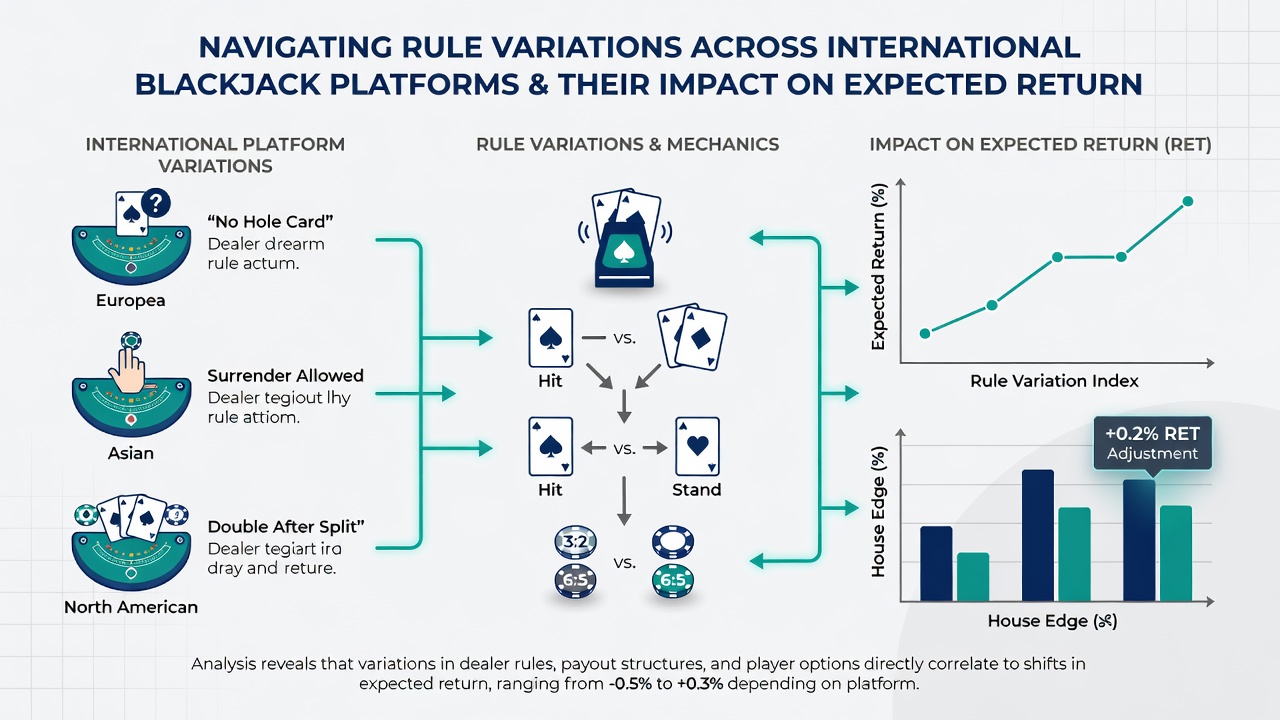
Blackjack operates under distinct rule sets that shift from one jurisdiction to another, and these differences directly alter the mathematical expected returns players encounter during play. Data from regulatory bodies show that small adjustments in dealer standing rules, deck penetration, or payout ratios create measurable changes in long-term outcomes. Observers note that platforms in North America often permit doubling after splits while many European venues restrict this option, which changes the edge calculations by fractions of a percent that accumulate over extended sessions.
Core Rule Elements That Drive Expected Value Shifts
Multiple factors combine to shape returns, and researchers track these variables through simulation models that process millions of hands. Dealer must-hit or stand-on-soft-17 decisions rank among the most influential, since a stand-on-soft-17 rule reduces the house advantage by roughly 0.2 percent according to aggregated industry analyses. Surrender provisions, when available, allow players to forfeit half their wager on poor initial hands, and studies indicate this option improves expected returns by 0.08 to 0.12 percent in multi-deck formats when applied correctly. Payout structures for natural blackjacks also vary, with 3-to-2 compensation remaining standard in many land-based settings while some online platforms shift to 6-to-5 ratios that increase the house edge by 1.4 percent.
Deck quantity and reshuffle frequency add another layer of complexity. Single-deck games in certain Asian markets deliver lower house edges than eight-deck shoe games common in Australian resorts, yet penetration rates determine how often favorable counts appear. Figures released in October 2026 by the New Jersey Division of Gaming Enforcement revealed that online platforms operating under Atlantic City regulations maintained consistent 0.5 percent house edges across multi-deck variants when surrender and double-after-split rules stayed intact.
Regional Platform Comparisons and Return Metrics
European venues frequently enforce no-hole-card procedures that require players to place additional wagers before dealer checks for blackjack, and this mechanic reduces expected returns by 0.11 percent in most cases. Canadian provincial casinos, by contrast, commonly allow players to double on any two cards while restricting splits to certain pairs, creating a distinct profile where expected values hover near 99.4 percent under optimal strategy. Australian gaming authorities publish quarterly reports that document how continuous shuffle machines in Queensland facilities limit card-counting opportunities and stabilize house edges near 0.7 percent across monitored tables.
Online platforms introduce further variations because software providers adjust rule parameters to meet licensing requirements in different markets. Malta-based operators, for instance, often incorporate early surrender and 3-to-2 blackjack payouts to align with EU standards, whereas Singapore-regulated sites maintain stricter hit-on-soft-17 mandates that elevate the house advantage slightly. Those who have examined cross-border data sets find that players switching between these environments encounter return fluctuations of 0.5 to 2.0 percent depending on the specific combination of rules encountered.
Quantifying Rule Effects Through Simulation and Regulatory Data
Academic researchers at institutions such as the University of Nevada, Las Vegas have published peer-reviewed models that isolate each rule variable and calculate its isolated contribution to overall expected value. Their findings indicate that permitting resplitting of aces improves player returns by 0.08 percent, while restricting doubling to hard totals of nine through eleven lowers returns by 0.18 percent in eight-deck configurations. Regulatory filings from the British Columbia Lottery Corporation further demonstrate that venues maintaining 75 percent deck penetration before reshuffles yield higher session performance metrics than those reshuffling at 50 percent penetration.
Platform operators respond to these dynamics by publishing house-edge disclosures that comply with local transparency mandates. As of October 2026, updated filings showed that several international sites adjusted payout ratios downward on side bets to offset more player-friendly core rules, keeping aggregate returns within narrow bands that satisfy both regulatory oversight and operational targets. Those monitoring these adjustments note that the interplay between visible rules and hidden procedural elements creates layered effects that standard strategy charts must address on a per-jurisdiction basis.
Practical Navigation of Rule Sets Across Borders
Players moving between international platforms benefit from consulting jurisdiction-specific strategy adjustments rather than relying on universal charts. A rule set that permits late surrender in multi-deck games requires different deviation indices than one without surrender, and simulation software tracks these differences with precision. Industry reports from the Australian Gambling Research Centre illustrate how rule awareness correlates with measurable shifts in average session returns when participants adapt their play accordingly.
Software certification labs test each platform against its stated rules before licensing approval, which ensures that published expected values align with actual game mechanics. Cross-referencing these certifications with regulatory databases allows observers to map return profiles accurately across regions without relying on anecdotal reports.
Conclusion
Rule variations across international blackjack platforms produce documented, quantifiable effects on expected returns that regulatory data and academic simulations consistently capture. Differences in dealer actions, surrender options, deck counts, and payout structures shift the mathematical baseline by fractions of a percent that compound over volume. Platforms operating under distinct licensing regimes continue to publish these parameters, enabling precise comparisons that reflect current conditions as of October 2026 and beyond.